Free delivery from 80 €. First order from 40 €: 10% off with code QELTIS10. We deliver in Portugal only.Delivery in Portugal only, free from 80 €. First order from 40 €: 10% off with QELTIS10
In eight short parts, from what methylation is to what is in each bottle, with the authorised claims.
01
What methylation is.
Methylation is one of the most common operations in the body. It consists of passing a small group of atoms, the methyl group, from one molecule to another.
It is a tiny chemical step, but the body turns it into a general-purpose tool: it is used to regulate the activity of genes, to transform nutrients, to make and recycle molecules and to process what is no longer needed. It happens in every cell, all the time.
02
Where methyl groups come from.
The body takes methyl groups from food and puts them into circulation. Methionine, an amino acid found in proteins, is the entry point to the cycle; serine, choline and betaine come in later, by different routes. Vitamins B12, B6 and B2 take part as components of the enzymes.
Proteins
Serine
Meat, fish, eggs, pulses and nuts.
Eggs and liver
Choline
Egg yolk, liver, fish and pulses.
Beetroot and cereals
Betaine
Beetroot, spinach and wholegrain cereals.
Folate does not bring methyl groups from food: it carries them within the body, with vitamin B12 as its partner, and the group it carries comes from serine.
03
The cycle, in four steps.
From methionine to SAMe. Methionine, an amino acid found in proteins, is charged with energy, with magnesium taking part in this step, and becomes SAMe, the molecule that hands out methyl groups throughout the body.
From SAMe to SAH. SAMe delivers the methyl group where it is needed and is left empty. It is then called SAH.
From SAH to homocysteine. SAH is converted into homocysteine.
From homocysteine back to methionine, or out of the cycle. Homocysteine can become methionine again, and the cycle restarts, by two pathways: the folate pathway, with vitamin B12, and the betaine pathway, with betaine formed from choline. Or it can leave the cycle through transsulfuration, as far as cysteine, with vitamin B6.
04
Homocysteine.
It is an intermediate amino acid of the cycle: it forms from SAH and disappears when it turns back into methionine or moves on to transsulfuration.
That is why its level in the blood says something about how the cycle is running, and it is one of the values doctors ask for in blood tests.
Authorised claims
Folate contributes to normal homocysteine metabolism.
Vitamin B12 contributes to normal homocysteine metabolism.
Choline contributes to normal homocysteine metabolism.
Vitamin B6 contributes to normal homocysteine metabolism.
05
Magnesium.
Magnesium takes part in hundreds of reactions in the body, including those that use the energy of cells.
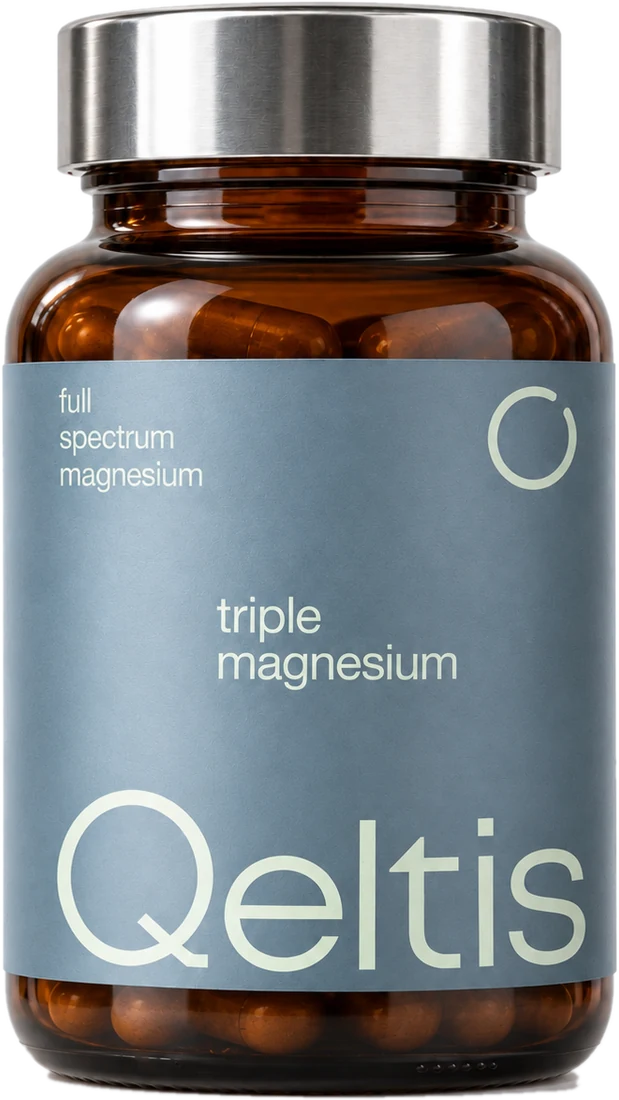
In triple magnesium, the mineral comes in three forms, bisglycinate, malate and taurate, with the amount of magnesium declared on the label.
Authorised claims
Magnesium contributes to normal energy-yielding metabolism.
Magnesium contributes to a reduction of tiredness and fatigue.
Magnesium contributes to normal functioning of the nervous system.
Magnesium contributes to normal muscle function.
Magnesium contributes to electrolyte balance.
Magnesium contributes to the maintenance of normal bones.
06
What is in each bottle.
A short summary of each product and the authorised claims for its nutrients. The full composition is on each product page.
Magnesium in three forms, bisglycinate, malate and taurate, with 190.52 mg of magnesium per dose.
Three forms of the same mineral, instead of just one, with the amount of magnesium declared on the label.
Magnesium contributes to a reduction of tiredness and fatigue.
Magnesium contributes to normal functioning of the nervous system.
Magnesium contributes to normal muscle function.
Claims from Regulation (EU) No 432/2012. Food supplements should not be used as a substitute for a varied and balanced diet and a healthy lifestyle.
07
Only what is authorised.
In the European Union, a health claim about a nutrient can only be used after EFSA has assessed the evidence and the European Commission has authorised the claim and set its conditions of use, including the dose. That is why, here and on the labels, you will only find authorised claims, and only when the product meets those conditions.
08
References.
Commission Regulation (EU) No 432/2012 of 16 May 2012 establishing a list of permitted health claims made on foods.
Regulation (EC) No 1924/2006 of the European Parliament and of the Council of 20 December 2006 on nutrition and health claims made on foods.
EFSA NDA Panel. Scientific opinions on the substantiation of health claims related to folate. EFSA Journal 2009;7(9):1213 (doi:10.2903/j.efsa.2009.1213) and 2010;8(10):1760 (doi:10.2903/j.efsa.2010.1760).
EFSA NDA Panel. Scientific opinions on the substantiation of health claims related to vitamin B12. EFSA Journal 2009;7(9):1223 (doi:10.2903/j.efsa.2009.1223) and 2010;8(10):1756 (doi:10.2903/j.efsa.2010.1756).
EFSA NDA Panel. Scientific opinions on the substantiation of health claims related to vitamin B6. EFSA Journal 2009;7(9):1225 (doi:10.2903/j.efsa.2009.1225) and 2010;8(10):1759 (doi:10.2903/j.efsa.2010.1759).
EFSA NDA Panel. Scientific opinion on the substantiation of health claims related to riboflavin (vitamin B2). EFSA Journal 2010;8(10):1814 (doi:10.2903/j.efsa.2010.1814).
EFSA NDA Panel. Scientific opinion on the substantiation of health claims related to choline. EFSA Journal 2011;9(4):2056 (doi:10.2903/j.efsa.2011.2056).
EFSA NDA Panel. Scientific opinions on the substantiation of health claims related to magnesium. EFSA Journal 2009;7(9):1216 (doi:10.2903/j.efsa.2009.1216) and 2010;8(10):1807 (doi:10.2903/j.efsa.2010.1807).